Thursday, April 20, 2023

“The Story of My Life” – An Autobiography of Cyclobenzaprine

Hello there…

I am Cyclobenzaprine

You may not call me by my full name often—some know me through prescriptions for muscle spasms, others as a quiet companion during painful nights. But my story? It’s one of transformation, adaptation, and purpose.

Let me tell you how I became who I am today.


๐Ÿงฌ My Origin – Born from an Idea (1960s)

I wasn’t created randomly. I was carefully designed in the 1960s, inspired by a class of compounds known as tricyclic antidepressants.

In fact, I closely resemble amitriptyline. Scientists were exploring molecules that could influence the central nervous system—and I emerged as a structural cousin with a slightly different destiny.

๐Ÿ‘‰ While they targeted depression… I found my purpose elsewhere.


๐Ÿ” The Discovery – A New Role Emerges

During early research, something interesting happened.

I didn’t show strong antidepressant effects like my relatives. But researchers noticed something unique:

๐Ÿ‘‰ I could reduce skeletal muscle spasms.

Not by acting directly on muscles… but by working centrally in the brainstem, reducing tonic somatic motor activity. My exact mechanism is 5-HT2 receptor antagonist, which is responsible for the antispasmodic effect due to inhibition of serotonergic, not noradrenergic, descending systems in the spinal cord.

That was my turning point.


๐Ÿ’Š My Entry into Medicine (1970s)

In the 1970s, I officially entered the medical world as a muscle relaxant.

Doctors began prescribing me for:

  • Acute musculoskeletal conditions
  • Painful muscle spasms
  • Short-term relief after injuries

I wasn’t meant for long-term use—I was designed for quick, effective relief.


⚙️ How I Work – My Inner Mechanism

Unlike many expect, I don’t act directly on muscles.

๐Ÿ‘‰ I act in the central nervous system (CNS)
๐Ÿ‘‰ I reduce motor neuron activity
๐Ÿ‘‰ I help muscles relax indirectly

Because of my tricyclic roots, I also carry:

  • Mild sedative effects ๐Ÿ˜ด
  • Anticholinergic properties

⚖️ My Strengths… and My Limits

I have helped many people find relief—but I come with responsibilities.

Effective for short-term muscle spasm relief
Improves mobility and comfort

But also:

⚠️ Can cause drowsiness
⚠️ Dry mouth, dizziness
⚠️ Not suitable for long-term or elderly use without caution

๐Ÿ‘‰ I always remind: Use me wisely.


๐Ÿงช My Life Today – Still Relevant

Even today, I remain a widely prescribed muscle relaxant across the world.

I am often used alongside:

  • Rest
  • Physiotherapy
  • Pain management strategies

I may not be as famous as some drugs… but for those in pain, I make a real difference.


❤️ My Message to You

I am not just a pill—I am the result of scientific curiosity and adaptation.

I wasn’t the best antidepressant…
But I became an effective muscle relaxant.

๐Ÿ‘‰ Sometimes, purpose is discovered—not designed.


Epilogue

From a chemical cousin of antidepressants…
To a trusted name in muscle relaxation…

This is my story.

I am Cyclobenzaprine—your silent reliever of muscle pain.
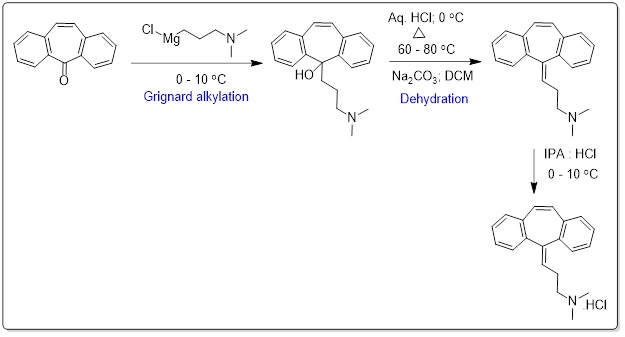
Synthesis


Other marketed muscle relaxants


Reference

NIH National library of medicine
WO 2012/098563/A2

Saturday, April 8, 2023

Characteristic groups - Suffixes and Prefixes

 SUFFIX and PREFIX

  • The presence of a characteristic (or functional) group is denoted by a prefix or suffix attached to the parent name
  • The most senior one, the principal characteristic group, is cited as the suffix, while all other groups are cited as prefixes.
  • For nomenclature purpose, C-C multiple bonds are not considered to be characteristic groups
Seniority order for characteristic groups

Examples

Reference

Brief guide to the nomenclature of organic chemistry, Pure Appl. Chem., 2020, 92(3), 527-536 

Nomenclature

IUPAC - International Union of Pure and Applied Chemistry, which provides recommendations on many aspects of nomenclature.

Nomenclature is a key tool for effective communication in the chemical sciences. There are 3 types of chemical nomenclature

  1. Nomenclature of Organic chemistry - Blue book
  2. Nomenclature of Inorganic chemistry - Red book
  3. Nomenclature of Polymer chemistry - Purple book
Substitutive Nomenclature

It is the main method for organic-chemical compounds. It is used mainly for compounds of carbon and elements of groups 13 - 17.

For naming purposes, a chemical compound is treated as

  • a combination of a parent compound and characteristic (functional) groups, one of which is designated the principal characteristic group
  • A systematic name is based on the name of most senior parent compound in which the substitution of hydrogen atoms is represented by a SUFFIX for the principal characteristic group(s).
  • PREFIXes representing less senior characteristic groups and other substituent groups, and locants that specify their locations.
Components of systematic substitutive names

  1. Locants - to indicate the position of substituents or other structural features.
  2. Enclosing mark, in the nesting order {[( )]} - to indicate which parts of a name belong together
  3. Multiplicative prefixes. Ex. trichloro...
(4S,5E)-4,6-dichlorohept-5-en-2-one

  • hept(a) - parent (heptane)
  • en(e) - unsaturation ending
  • di - multiplicative prefix
  • 2, 4, 5, 6 - locants
  • one - suffix of principal characteristic group
  • chloro - substituent prefix
  • E S - stereodescriptors
  • ( ) - enclosing marks
Creation of systematic names

The following order is used for the formation of systematic name
  1. Determine the principal characteristic group to be cited as the SUFFIX.
  2. Determine the senior parent amongst those structural components attached to a principal characteristic group.
  3. Name the parent hydride and specify any unsaturation.
  4. Combine the name of the parent hydride with the suffix for the principal characteristic group.
  5. Identify the substituents and arrange the corresponding prefixes in alphabetical order.
  6. Insert multiplicative prefixes, without changing the already established order, and insert locants.
  7. Determine the chirality centres and other stereogenic units, such as double bonds, and add stereodescriptors.
Reference
Brief guide to the nomenclature of organic chemistry, Pure Appl. Chem., 2020, 92 (3), 527 - 539.

“The Story of My Life” – An Autobiography of Ibuprofen

Hello… I am Ibuprofen . You’ve probably met me during a headache, fever, or inflammation. I may seem like just another tablet—but my journey...